
Dharmendra Pradhan Resigns as India’s Education Minister Amid Nationwide ‘Cockroach’ Protests
Union Education Minister Dharmendra Pradhan has resigned following weeks of nationwide student-led protests over alleged exam paper leaks, marking the first major concession from PM Modi's government.
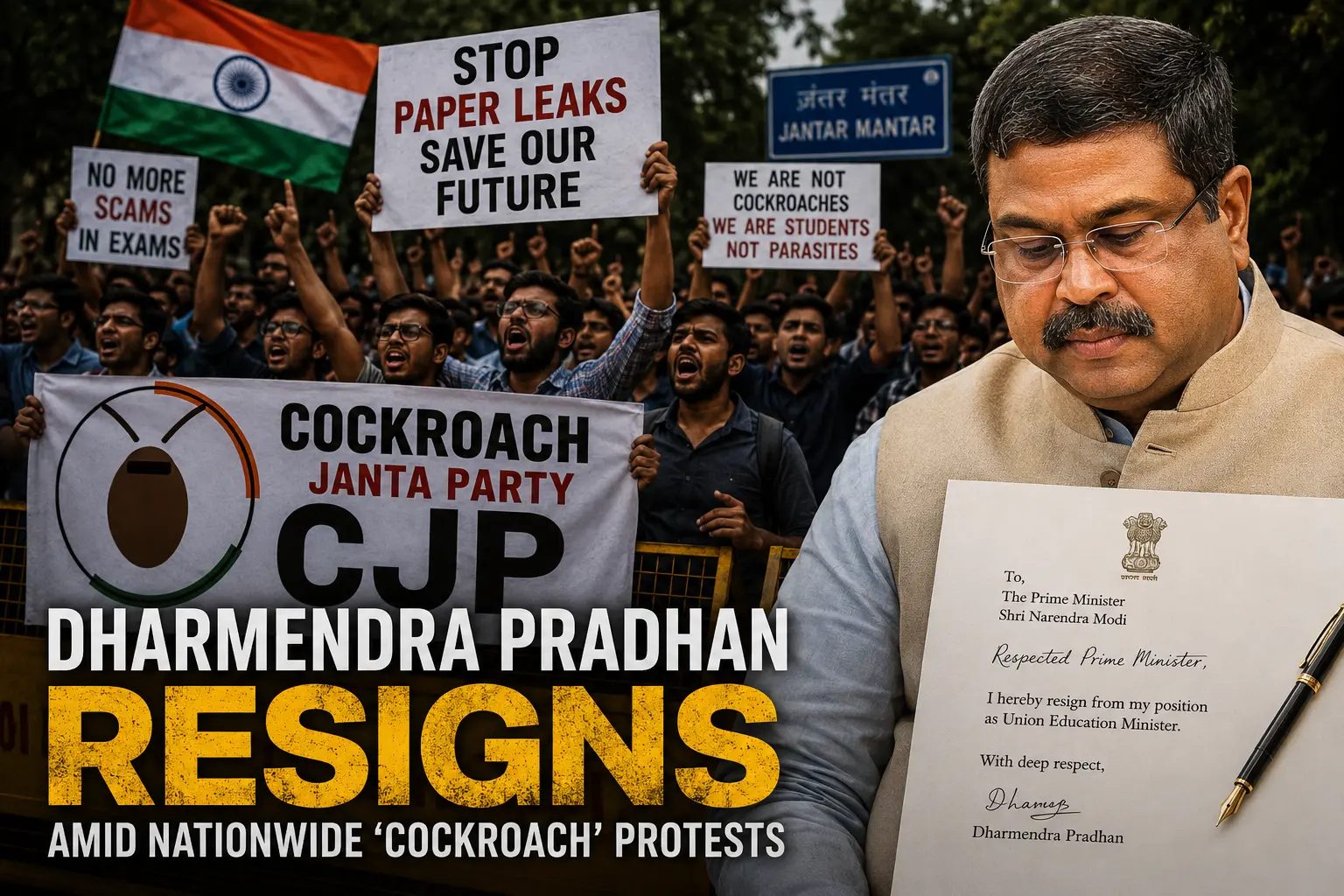
Dharmendra Pradhan Resigns as India’s Education Minister Amid Nationwide ‘Cockroach’ Protests
New Delhi, July 25, 2026 — Union Education Minister Dharmendra Pradhan resigned on Saturday, becoming the first senior member of Prime Minister Narendra Modi’s government to step down amid weeks of escalating nationwide protests led by young people demanding accountability over a series of examination paper leaks. The Dharmendra Pradhan resignation marks one of the biggest concessions won by a youth-led protest movement in India in recent years.
Pradhan announced his resignation on his official X (formerly Twitter) post, sharing a letter addressed to Prime Minister Modi. In it, he said the decision was guided by concern for students’ futures and a wish to prevent the situation from being “taken advantage of” by outside interests.
“Considering the situation that has arisen at Jantar Mantar and across the country, so that anti-national forces do not take advantage of this situation… I have sent my resignation letter to the Prime Minister,” Pradhan wrote, adding that he holds “deep respect for the aspirations, sentiments, and rightful expectations of the youth of this country.”
Dharmendra Pradhan’s official resignation post, shared on X.
— Dharmendra Pradhan (@dpradhanbjp) July 25, 2026
What Triggered the Protests Behind Dharmendra Pradhan’s Resignation
The unrest traces back to the alleged leak of a high-profile national medical entrance examination paper in May 2026, which affected roughly two million students and led to the cancellation of results and an ordered retest. Anger over the leak, combined with separate complaints about irregularities in board exam evaluation processes, snowballed into a broader youth movement demanding Pradhan’s resignation and systemic reform of how public examinations are conducted. If you’re curious how India’s exam boards are structured, our explainer on the CBSE full form and its role in Indian education offers useful background on the examination system at the heart of this controversy.
The demonstrations, now widely referred to as the “Cockroach” protests, were organised by the Cockroach Janta Party (CJP), a youth-led satirical political movement founded by digital strategist Abhijeet Dipke, along with several student organisations. The unusual name stems from a remark by the Chief Justice of India, who had compared unemployed youth and social media activists to “cockroaches” and “parasites” — a term the movement chose to reclaim. A detailed, continuously updated account of the demonstrations is available on Wikipedia’s page on the 2026 Delhi Jantar Mantar protests.
What began as an online movement in May grew into sustained, large-scale demonstrations centred at Jantar Mantar in New Delhi from early June, spreading to cities including Mumbai, Hyderabad, Bengaluru and Ahmedabad. The protests gained further national attention after Ladakhi environmentalist and education activist Sonam Wangchuk began an indefinite hunger strike at the protest site on June 28.
Clashes With Police
Tensions escalated sharply this week when protesters attempted to march toward Parliament. Authorities responded by restricting mobile internet access, erecting barricades and closing metro stations near the demonstration site. Police used tear gas and baton charges to disperse the crowds, with protesters and independent witnesses reporting that dozens of demonstrators were injured. Delhi Police have denied allegations of excessive force. NPR’s on-the-ground reporting documented tear gas being used to disperse demonstrators during the march toward Parliament.
According to reports from the scene, at least 1,000 police personnel were deployed around Jantar Mantar in the hours surrounding Pradhan’s resignation announcement.
Celebrations at Jantar Mantar
News of the Dharmendra Pradhan resignation was met with jubilant scenes at the protest site, where demonstrators sang the national anthem, shouted “Jai Hind” and distributed sweets. “We have done it,” CJP founder Abhijeet Dipke told supporters to loud cheers. Similar celebrations were reported in other cities where the movement had taken root. Al Jazeera’s coverage and NBC News’s report both described the scenes as some of the largest displays of public dissent India has seen in recent years.
The resignation came just hours before a scheduled third round of talks between protest leaders and government ministers, and is being widely described as the first major concession from the Modi government in the face of what commentators have called one of India’s largest youth-led protest movements in recent years. Opposition politicians had also joined calls for Pradhan’s resignation and disrupted parliamentary proceedings over the issue.
What Happens Next After Dharmendra Pradhan’s Resignation
Pradhan, a senior Bharatiya Janata Party leader who has held the education portfolio since 2021 and previously served as petroleum minister, thanked his cabinet colleagues and ministry staff in his resignation letter, saying that “serving the nation is my highest priority in life.” No successor has been named as of publication. Protest organisers have indicated that broader demands — including systemic exam-reform measures — remain on the table for the next round of talks with the government.
For more breaking developments from India, browse our India News section or explore our wider Education category for coverage of exam policy and reform stories.
This is a developing story on the Dharmendra Pradhan resignation and will be updated as more details emerge.